// Skills & plugins · Free PDF
The elephant plans, the goldfish reviews: the Elephant Goldfish Model
The Elephant Goldfish Model for Claude Code, Codex and Antigravity: what it is, how to install it with two commands, the workflow step by step, prompts to copy, and how to use the idea without the plugin for websites, ads and content.
Independent: I have no connection to Google, and this isn't an ad. Everything here is based on my own research in the repo and the official docs.
At a glance
| Question | In short |
|---|---|
| What is it? | An open-source plugin (Apache 2.0) that has your AI plan first, then has fresh sub-agents review the plan before anything gets built |
| Who made it? | Published in Google's GitHub (google/elephant-goldfish-model). The README says it is not an officially supported Google product |
| The idea | An essay by Dave Rensin, Distinguished Engineer at Google |
| Runs in | Claude Code, Codex, Antigravity (plus Claude Cowork and ChatGPT Work, according to the docs) |
| Cost | The plugin is free. It uses your existing plan or API costs, and a review starts several sub-agents, which uses noticeably more |
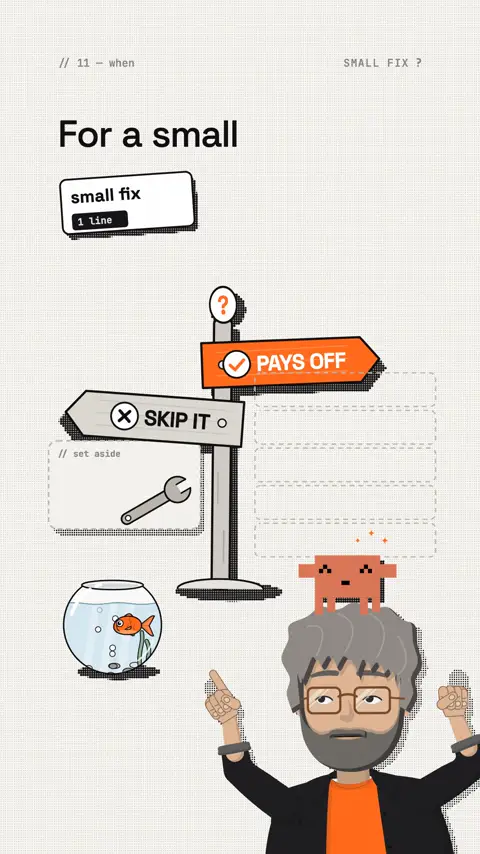
| When to use it | Whenever decisions have to be made before building. Not for a small, clear fix |
Why AI plans have gaps nobody sees
The longer you work with an AI on a project, the more it knows: your audience, your prices, the tone you like, what you threw out three days ago. That makes it a good planner. It also makes it blind, in a very human way.
Whoever knows everything stops noticing what isn't written down. The AI reads its own plan and fills in the missing parts in its head: the opening hours that came up in the chat, the cancellation rule you mentioned once in passing. You read the plan the same way, because you share the same memory. For both of you it is complete.
For everyone else it isn't. For the AI that builds from it tomorrow in a new session. For the colleague who takes over. And above all for your customers, who only see what is actually there in the end. That is exactly the gap the Elephant Goldfish Model closes: it has the plan read by someone who knows nothing.
Elephant, goldfish, you: the three roles
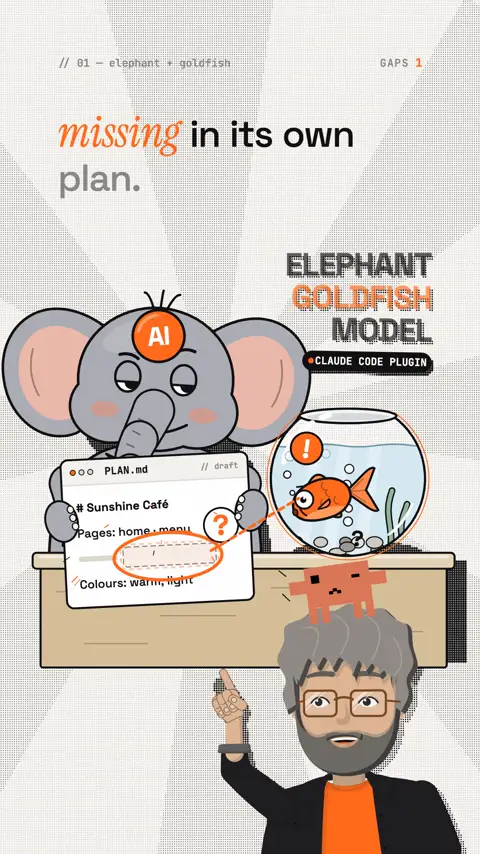
The elephant is the AI you've been working with on your project for a long time. It knows your goals, your style and every decision. That's why it writes you a good, detailed plan.
The problem: because it knows everything, it fills the gaps in its head. It assumes things nobody ever wrote down, and it stops noticing what the plan is missing.
The goldfish is a fresh sub-agent with no memory. It only sees the plan and the sources the plan points to, not your conversation. It reads the plan like a stranger, and strangers spot gaps instantly. In Claude Code these reviewers even get read-only access: they can't change files or run commands.
You decide. You look at what the goldfish found, pick what matters and approve the plan. Only then does it get built.
The elephant plans, the goldfish review, you decide. That's the whole principle, and that's exactly why it works.
What the video doesn't say
- "From Google" is only half true. The repo lives in Google's GitHub and was introduced on the Google Open Source Blog. But the README says plainly: not an officially supported Google product.
- Built for software planning. The docs talk about design documents and specs before code. Using it to plan websites, ads or carousels is a transfer of the idea, not an official feature. It still works, see "Without code".
- Sub-agents are required. If your tool can't start fresh sub-agents, EGM stops the review. Claude Code can.
- Check your version. For verified goldfish isolation, the plugin's Claude docs ask for Claude Code 2.1.271 or later.
claude --versionshows yours. - Lots of feedback is intentional. The guide says, in short: the review gives a lot on purpose. Take what's relevant, ignore the rest.
- Not a replacement for tests. According to the README, a review replaces neither tests nor your own judgment.
Installing in Claude Code
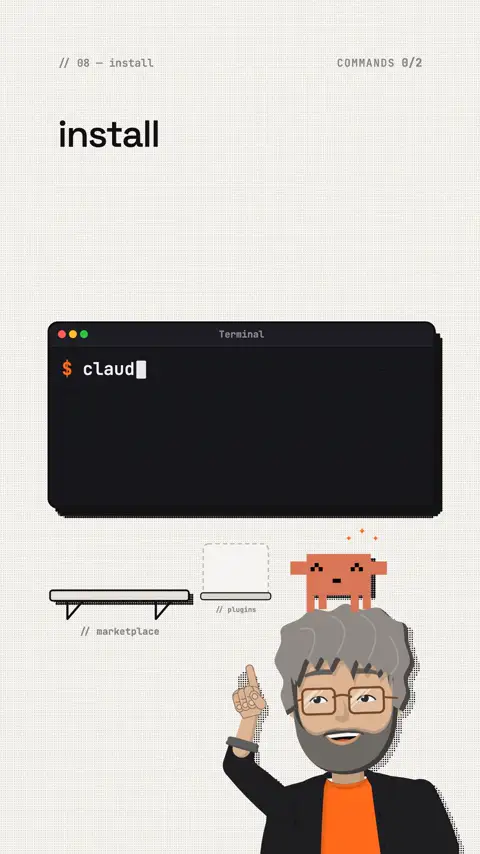
In the terminal, one after the other:
Command
claude plugin marketplace add google/elephant-goldfish-model
claude plugin install egm@egm
Then start a new session. If the plugin isn't active:
Command
claude plugin enable egm@egmCodex:
Template
codex plugin marketplace add google/elephant-goldfish-model
codex plugin add egm@egm
In Codex you pick the EGM skills in the skill picker instead of a slash command.
Antigravity CLI:
Template
agy plugin install https://github.com/google/elephant-goldfish-modelThe workflow step by step
In Claude Code every command starts with /egm:.
- Test the idea:
/egm:egm-brainstormplus your idea in one sentence. You clarify requirements and trade-offs, fresh reviewers challenge the idea, and you end up withconcepts_brief.md. - Write the plan:
/egm:egm-draft. The elephant turns the brief into the plandesign_draft.md, section by section, and pauses after each section so you can give feedback. - Review the plan:
/egm:egm-review design_draft.md(use the path the agent gives you). Several goldfish review the plan in stages: the big picture, whether it's understandable, the design, the fit with the code, and whether someone could build from it. - Choose: You go through the findings and decide what to change. The
egm-resolveskill helps with that. - Build: Only when you approve the plan do you tell your agent to build it.
The other skills
| Skill | What for |
|---|---|
| resolve | Go through review findings one by one and agree on changes |
| review-loop | Run your own group of reviewers for a specific task |
| bootstrap | Generate READMEs bottom-up for an existing project so the elephant finds its way |
| drift-report | Compare plans with the current code. The docs recommend once a week |
You don't always have to do every step. Use the skill that's your bottleneck right now.
Prompts to copy
Replace everything in [square brackets].
1. Start the brainstorm
Prompt to copy
/egm:egm-brainstorm [What I want to build, in one sentence]. Audience: [who]. Must do: [3 things]. Must not happen: [1-2 things]. Ask me the questions you need first.2. Have the plan written
Prompt to copy
/egm:egm-draft Turn concepts_brief.md into a plan. Stop after each section and ask me before you continue. Include everything a stranger needs to know to build from it.3. Start the review
Template
/egm:egm-review [path to design_draft.md]4. Sort the findings
Prompt to copy
Sort the review findings into three groups: must be fixed before building, should be fixed, can wait. One sentence per finding on why. Show me the three most important first.5. Then build
Prompt to copy
The plan in [path] is approved. Build it exactly like this, section by section. If anything in the plan is missing or unclear, stop and ask me instead of guessing.6. Compare after building
Prompt to copy
Compare what was built with the plan in [path]. List everything that differs and say for each point whether the plan or the result should change.Without code: the principle for anything a stranger sees
Every customer is a goldfish. Someone scrolling Instagram, seeing your ad or landing on your site doesn't know you and has no context. That's exactly how a goldfish reviewer reads.
You can rebuild this without the plugin too, in Claude Code with sub-agents or in the Claude app with a new chat:
- Have your "elephant" (the chat with all your context) write a short plan: goal, audience, content, structure, copy.
- Copy only the plan into a new chat, with no history.
- Give it a role with the prompt below.
- Bring the findings back to the elephant, choose, and only then build.
Prompt to copy
You have never seen this project. You are [someone scrolling Instagram / a visitor landing on this page for the first time / a skeptical buyer]. Read only the plan below. Tell me: 1) What don't you understand in the first 3 seconds? 2) Which claim don't you believe without proof? 3) What's missing for you to act? 4) What would you cut? Plan: [paste plan]Reviewer roles worth using
| Role | Checks |
|---|---|
| Scroller | Does it make sense in one second with the sound off? |
| First-time visitor | Is it clear what you offer and what the next step is? |
| Skeptic | Which claim is unproven or sounds too big? |
| Buyer | Price, process, risk: is anything missing for the decision? |
| Phone checker | Is every text readable on a phone, every button big enough? |
Example: a page plan before and after the goldfish
A made-up but typical example: the elephant planned a landing page with you for a café that delivers breakfast. In the chat everything was clear. Three fresh reviewers read only the plan.
| What the goldfish asks | What was missing from the plan | What you change |
|---|---|---|
| "Where do you deliver?" | The delivery area was only in the chat | Postcodes and minimum order go into the plan |
| "What happens after I click Order?" | The button had no target | Define the order flow: form, confirmation, payment |
| "When do I have to order by?" | The cut-off the day before was never mentioned | One sentence right next to the button |
| "Can I read this on my phone?" | No minimum text size | Set a minimum size for text and buttons |
| "Where does 'the most popular box in town' come from?" | A claim without proof | Back it up or cut it |
None of these is hard to fix. They only get expensive when they show up after the build, or when a customer finds them. In the plan they cost a few sentences.
Who gains what?
| Who | Problem | What you do with EGM |
|---|---|---|
| Developers | The AI starts building and guesses what's missing | Plan, review, then code |
| Freelancers with a website | The site looks nice, but visitors don't get the offer | First-time visitor and buyer review the page plan |
| Creators | A carousel or reel only makes sense with context | Scroller and skeptic review the script |
| Agencies | Client projects go back and forth five times | The plan gets reviewed before the client sees it |
| Teams | Everyone has a different picture in mind | The approved plan is the shared picture |
Limits and risks
- More usage: A review starts several sub-agents in sequence and in parallel. That uses noticeably more of your limit or API budget.
- Time: For a small, clear fix it isn't worth it. The docs say so too.
- Permissions: The reviewers read files from the plugin folder. Claude Code asks for permission. Only allow the folders the docs name, not everything.
- No replacement for tests and people: The goldfish find gaps in the plan; they don't test the finished result.
- New: The first release came out in October 2026. Commands and workflows can change. Check the README before you start.
EGM plugin or just a new chat?
You don't need the plugin to use the principle. But it makes the process more thorough and repeatable.
| New chat with only the plan | EGM plugin | |
|---|---|---|
| Setup | None | Two commands, Claude Code 2.1.271 or newer |
| Reviewers | One, with the role you give it | Several, with fixed angles and in stages |
| Memory | Truly fresh, as long as you paste only the plan | Fresh sub-agents, read-only in Claude Code |
| Good for | Pages, ads, carousels, scripts, emails | Software projects, bigger undertakings, teams |
| Effort | Copy, paste, bring the findings back | Guided from brainstorm to review |
| Cost | One extra chat | Several sub-agents, noticeably more usage |
My way: for content a stranger will see, a new chat is often enough. As soon as code is involved or several people depend on the plan, the plugin pays off.
Quick check: is EGM worth it for your project?
Think of the next thing you want to build and answer four questions.
Answer all four questions to see the recommendation.
For this project it is enough to just build. Plan and review cost more here than they bring.
Have the elephant write a short plan and paste only the plan into a new chat, with the prompt from the "Without code" section.
Brainstorm, draft, review: this is where the goldfish finds the gaps your customers would otherwise find. Start with the two install commands above.
Your first hour
- Check
claude --version(2.1.271 or later) - Run the two install commands, start a new session
- Pick something you actually want to build right now
/egm:egm-brainstormwith one sentence about your idea/egm:egm-draftand give feedback after each section/egm:egm-reviewon the plan- Pick the three most important findings and work them in
- Only then have it built
- Compare the result with the plan (prompt 6)
My tip
Don't start with your biggest project. Pick something a stranger will see: a landing page, an offer page, a carousel. That's where you notice fastest how much the elephant takes for granted.
And if the plugin feels like too much: a new chat with only the plan is already a goldfish. The plugin's own guide recommends doing the workflow by hand a few times before automating it.
All links and commands checked on the official pages on November 3, 2026.
Essay by Dave Rensin · Google Researchresearch.google the idea behind elephants and goldfish Introduction on the Google Open Source Blogopensource.googleblog.com October 22, 2026, why the plugin existsYour elephant knows too much. Give your plan to a goldfish before your customers see it.
The reel on this topic
This reel was made with Mentor Reels
Mentor Reels is a skill for Claude Code. From one prompt it makes a finished explainer reel with voice, animation, post texts and a PDF just like this one.
Read the transcript
An elephant and a goldfish show you exactly what your AI keeps missing in its own plan. By the end you'll know when this pays off and when to skip it. First: I have no connection to Google, and this isn't an ad. I looked at the plugin closely myself. It's called the Elephant Goldfish Model, EGM for short. Open source, free, for Claude Code, Codex and Antigravity. The idea comes from Dave Rensin, an engineer at Google. The AI you've been working with for a long time is the elephant. It forgets nothing and writes you a good plan. But it fills the gaps in its head and stops noticing what the plan is missing. A goldfish is a fresh sub-agent with no memory. It only gets the plan and reads it like a stranger. And strangers spot gaps instantly. That's exactly how every customer sees you: someone scrolling Instagram or landing on your site doesn't know you. Every customer is a goldfish. You install it with two commands in the terminal, then you start a new session. Then three steps: Brainstorm tests your idea. Draft writes the plan, section by section. Review sends several goldfish out, each with its own job. That gives you a lot of feedback on purpose. You take what matters, and only then does it get built. The elephant plans, the goldfish review, you decide. For a small fix, skip it. It pays off for anything a stranger is going to see. Follow me and comment elephant, and I'll send you the guide with every command and prompts to copy.
Frequently asked questions
What is the Elephant Goldfish Model?
A free open-source plugin (Apache 2.0) for AI coding agents like Claude Code, Codex and Antigravity. Your AI, the elephant, writes a plan first. Then fresh sub-agents with no memory, the goldfish, review that plan like strangers and find gaps, unclear requirements and risks. You decide what matters, and only then does it get built.
Is it an official Google product?
Not quite. The repo lives in Google's GitHub (google/elephant-goldfish-model) and was introduced on the Google Open Source blog. But the README says explicitly that it is not an officially supported Google product. The idea comes from an essay by Dave Rensin, Distinguished Engineer at Google. I have no connection to Google, this is my own research.
How do I install EGM in Claude Code?
Two commands in the terminal: claude plugin marketplace add google/elephant-goldfish-model, then claude plugin install egm@egm. Then start a new session. For verified goldfish isolation the plugin's guide requires Claude Code 2.1.271 or newer, claude --version shows yours. The commands for Codex and Antigravity are in the guide.
How does an EGM run work?
With /egm:egm-brainstorm you test the idea and end up with a concepts brief. With /egm:egm-draft the elephant turns it into a plan section by section and stops after each one for your feedback. With /egm:egm-review several goldfish review the plan in stages. With egm-resolve you go through the findings, and only after your approval does it get built.
What does it cost?
The plugin itself is free. It runs on your existing plan or API costs. But a review starts several sub-agents in sequence and in parallel, which uses noticeably more of your limit or budget than a normal chat. So it pays off for work with real decisions, not for every small thing.
Does it work without coding skills?
Yes. The plans are in plain language and you describe your idea in plain words. EGM is built for software planning, but the principle fits anything a stranger sees: websites, ads, carousels, scripts. Without the plugin you use a new chat and paste in only the plan. The guide has a prompt and five reviewer roles for that.
When is EGM not worth it?
For small, clear changes like a typo or a new headline. The plugin's docs say the same. A review also replaces neither tests nor your own judgement: the goldfish find gaps in the plan, they don't check the finished result. And because the plugin is new, commands may still change, so check the README.
What are the other skills like resolve and drift-report?
resolve walks you through the review findings one by one. review-loop runs your own group of reviewers for a specific task. bootstrap writes descriptions for an existing project so the elephant can find its way around. drift-report compares your plans with what was actually built, the docs recommend running it once a week.
Keywords
Goes well with
-
// Skills, repos & add-ons
How to choose the right Claude skills: find your perfect skill combo
Why more skills don't help more, what skills.sh really shows, and how Claude finds the right combo with you.
-
// Claude Code & the desktop app
Claude Code Desktop: every update in the "V2"
What's inside the new Claude desktop app: 20 features with plan, where to click and shortcuts, plus seven workflows where they work together.
-
// Claude Code & the desktop app
My Claude V2 blueprint: every project from one main chat
One main chat, one session per step: how I pitch an idea in Claude Code, roast it, check it against real search numbers and build it.
-
// Skills, repos & add-ons
BAMA and REA: rebuild Mac apps with Claude
BAMA rebuilds native Mac apps with 21 skills, REA explains how an app works. Links, install steps, costs and where the legal line is.
The elephant plans, the goldfish reviews
A free open-source plugin from Google's GitHub: your AI writes the plan, fresh sub-agents with no memory review it like strangers, you decide, then it gets built. Install in two commands, the workflow step by step, prompts, and how to use the principle without code.