// Workflows · Free PDF
Your AI council in Claude: seven advisor roles for real decisions
Everything from the video and more: what roast-room is, how to install it step by step, all modes, what it costs your limit, the checklist for the perfect question, and what you can and can't expect from it.
At a glance
| Question | Short answer |
|---|---|
| What is it? | roast-room, a free Claude Code skill by Nate Herk / AI Automation Society (MIT) |
| What does it do? | Seats 5 to 7 AI advisor roles around your decision, Claude moderates three rounds |
| Who sits there? | 7 by default, 12 in total, each built from that person's public work |
| What do you get? | A verdict with scores per option, the dissent and next steps, as a PDF too |
| What do you need? | Claude Code with your Claude plan (no API key), Node.js 20+ for the optional room |
| What does it cost? | Free. Usage: a full council ≈ 21 sub-agent runs, about 1M tokens (per its own docs) |
What's really behind an advisor
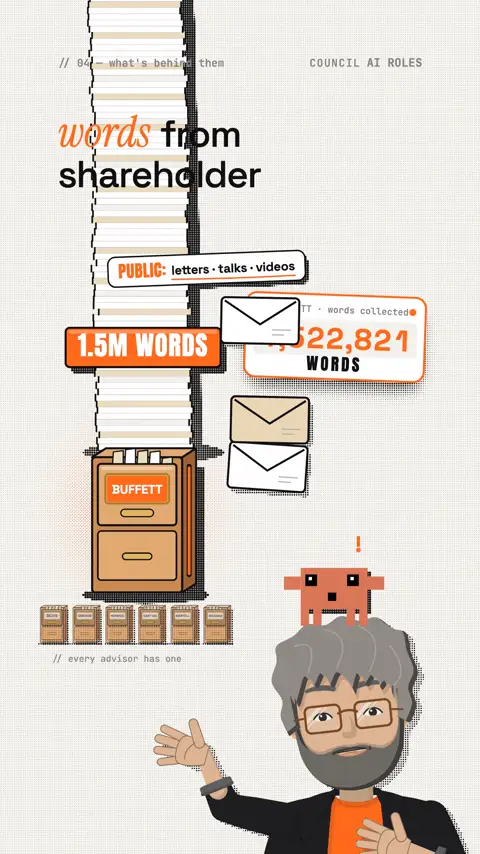
Each seat is a Claude sub-agent with its own "brain": a folder of frameworks, principles, positions, stories and voice notes, compiled from what that person said in public. Every quote is tied to its source, and a script checks that quotes appear word for word in the sources.
| Advisor | Sources in the brain |
|---|---|
| Warren Buffett | 103 sources, about 1.5M words: shareholder letters, annual-meeting transcripts, interviews |
| Jeff Bezos | 68 sources: 24 shareholder letters, talks and interviews, about 374,000 words |
| Alex Hormozi | 124 video transcripts, about 1.3M words |
| Paul Graham | 231 essays plus talks |
They're simulations, not the people. They don't speak for them, and none of them endorses the project. That's in the README, and it belongs in your head too.
Who sits at the table
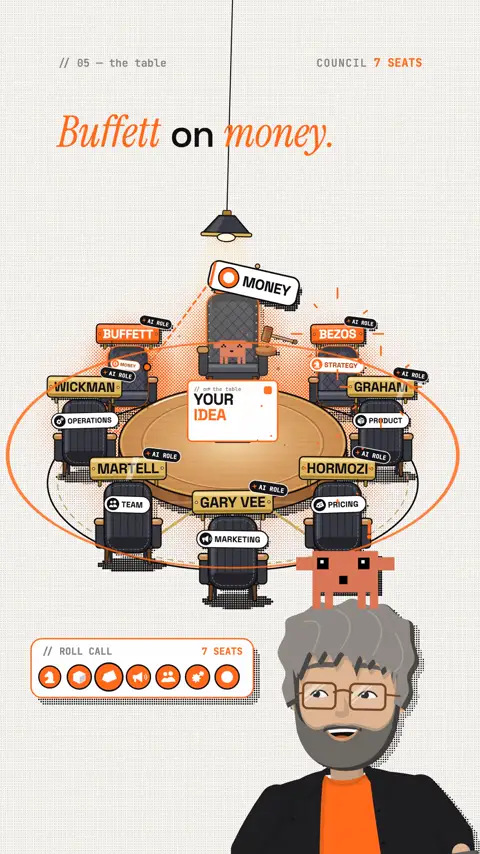
| Seat | Area | The question they own |
|---|---|---|
| Jeff Bezos | Strategy | Is this the right bet, and how reversible is it? |
| Paul Graham | Product | Do people actually want this, and is it growing? |
| Alex Hormozi | Pricing and sales | Will people pay, how much, and how do we close? |
| Gary Vaynerchuk | Marketing | Where does the attention come from? |
| Dan Martell | Team and founder time | Who does this, and what does it cost your calendar? |
| Gino Wickman | Operations | Can the business run this without you holding it together? |
| Warren Buffett | Money | What does it do to cash, risk and long-term value? |
On call, when your question needs them: Naval Ravikant (leverage), Codie Sanchez (buying businesses), Leila Hormozi (leadership), Sara Blakely (consumer products), Elon Musk (first principles). The Chair recommends a council per question and you confirm it.
Install in 5 minutes
You need Claude Code and, for the visual room, Node.js 20 or newer.
- Open a terminal and clone the repo, or tell Claude Code: "Clone github.com/nateherkai/roast-room and start the room for me."
Command
git clone https://github.com/nateherkai/roast-room.git
cd roast-room- Optional, the room with the table:
npm start, then open http://localhost:4730 and leave it open. - Start Claude Code in the same folder:
claude - Type
/roast-roomand your decision. - Answer the Chair's questions, then watch the council argue it out.
- When the verdict lands, click Download PDF. The full report is also in
sessions/<date>-<decision>/verdict.md.
All modes
| Command | What it does |
|---|---|
/roast-room … | Full council: the Chair recommends 5 to 7 seats, three rounds |
/roast-room --quick … | 4 seats, 2 rounds (a third only if needed). For smaller, reversible calls |
/roast-room --seats hormozi,buffett … | Only the seats you name |
/roast-room ask hormozi … | One answer from one seat |
/roast-room --all … | Every advisor you have (up to nine) |
/roast-room board | Shows and changes your default board |
/newroaster <name> | Builds a new advisor from public sources (about 8 to 10 sub-agent runs) |
What it costs your limit
The skill is free. The usage is yours: according to its own instructions, a full council is three sub-agent runs per seat, 21 for seven seats, "about 1M tokens". For comparison, the hyped Arena skill from my last video needs 595 calls and an estimated 39 million tokens for its default run.
Token tip: use --quick for everyday questions, --seats with the two or three areas that matter, or ask for a single opinion. Keep the full council for decisions that are expensive or hard to undo. Check /usage in Claude Code after a run.
The checklist for your perfect question
The council is only as good as what you give it. Put this into your question:
- The decision in one line
- Your options: two or three ("keep doing what I do now" counts)
- Your numbers: revenue, cash, team size
- Your limits: deadline, hours, budget
- What success looks like, and by when
- Which way you're leaning, and why: the council tests your lean instead of agreeing with it
Copy this prompt
Prompt to copy
/roast-room Decision: [one line]. Options: [A], [B], [keep doing what I do now]. Numbers: revenue [ ], cash [ ], team [ ]. Limits: deadline [ ], hours per week [ ], budget [ ]. Success: [what, by when]. I'm leaning toward [option] because [reason].What you can expect, and what you can't
- You get several sharp perspectives on one decision, scores per option, the strongest objections, the dissent and concrete next steps.
- You don't get the real people, investment or legal advice, or a guarantee. The roles are trained on public material, not on your market.
- It's for business decisions: pricing, hiring, a new product, a partnership, spending. For personal questions it isn't built.
- Not only Claude? Officially it needs Claude Code. Its instructions include a fallback "without sub-agents" (Codex is named) where one model plays the seats one after another. That works, but less cleanly. My next video shows a council that works in any AI without installing anything.
My tip
Write your question with the checklist above before you start, and say honestly which way you're leaning. That's where the council is most useful: when it disagrees with you.
All links, commands and numbers checked on 28 Oct 2026 in the repo (README, SKILL.md, roster.json, the brains' source lists). Credit: roast-room by Nate Herk / AI Automation Society, MIT licence.
The reel on this topic
This reel was made with Mentor Reels
Mentor Reels is a skill for Claude Code. From one prompt it makes a finished explainer reel with voice, animation, post texts and a PDF just like this one.
Read the transcript
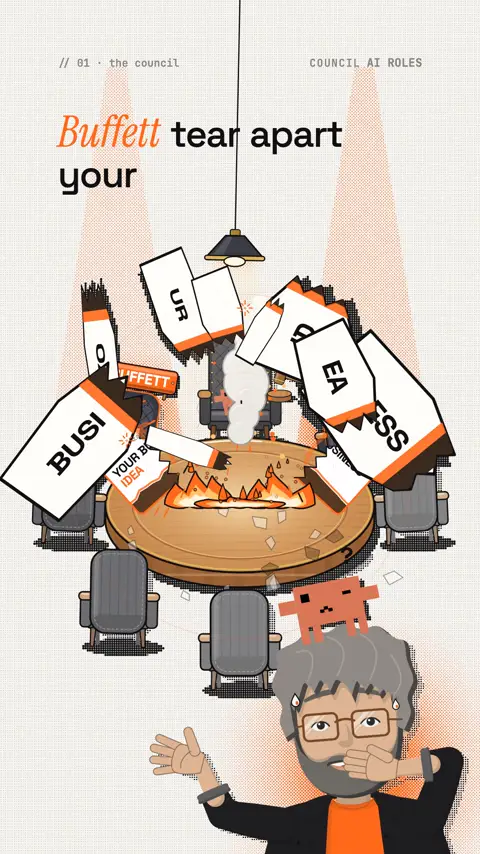
Jeff Bezos and Warren Buffett tear apart your business idea, right inside Claude. Not the real ones, of course, but what's behind them is wilder than you think. The skill is called roast-room, free from Nate Herk and his AI Automation Society. For every advisor, they collected everything he has said in public. For Buffett, that's one and a half million words from shareholder letters and annual meetings. At the table: Bezos on strategy, Graham on product, Hormozi on pricing, Gary Vee on marketing, Martell on team, Wickman on operations, Buffett on money. Claude moderates three rounds: score, argue, vote, and at the end you get a verdict with next steps. And your limit? By its own docs, a full council takes about one million tokens, almost forty times less than the Arena. On a Pro plan, use quick mode with four advisors for smaller calls. You can bring them any decision, a new business idea, a price increase or your first hire. The more precisely you describe your situation, the more honest the verdict, and if something's missing, Claude asks. Follow me and comment COUNCIL, and I'll send you the install guide and the checklist for your perfect question.
Frequently asked questions
What is roast-room?
roast-room is a free Claude Code skill by Nate Herk and his AI Automation Society (MIT licence). It seats five to seven AI advisor roles around your decision, and Claude moderates three rounds. You get a verdict with scores per option, the dissent and next steps, as a PDF too.
Are those really Buffett, Bezos and Hormozi talking?
No. They are simulations built from what these people said in public. For Buffett that's 103 sources with about 1.5 million words from shareholder letters, annual meetings and interviews. According to the README the roles don't speak for the people, and none of them endorses the project.
How do I install roast-room?
Clone the repo with git clone https://github.com/nateherkai/roast-room.git, start Claude Code in the folder with claude and type /roast-room plus your decision. Optionally, npm start opens the room with the table at http://localhost:4730. You need Claude Code with your Claude plan, no API key, and Node.js 20 or newer for the room.
How much of my limit does a council use?
According to its own instructions, a full council is three sub-agent runs per seat, 21 for seven seats, about 1 million tokens. For smaller calls there is --quick with four seats and two rounds. Anthropic doesn't publish how many tokens fit into a Pro plan, so check /usage after a run to see what it cost.
What should I put into my question?
The decision in one line, two or three options ("keep doing what I do now" counts), your numbers such as revenue, cash and team size, your limits, what success looks like, and which way you're leaning and why. If something is missing, the Chair asks before the council starts.
Does roast-room work without Claude?
Officially it needs Claude Code. Its instructions include a fallback without sub-agents, where one model plays the seats one after another, and Codex is named there. That works, but less cleanly.
Keywords
Goes well with
-
// AI workflows for business
What Arena really costs your limit: the full math behind the hype skill
Arena pits 100 Claude agents against each other. What that costs in tokens, what one tester measured, and how to check any skill before you install it.
-
// AI workflows for business
Claude becomes your SEO machine: real search data instead of guessed numbers
Why Claude guesses at search volume, how it pulls real Google numbers through DataForSEO, and why full keyword research costs only cents.
Your AI council for real decisions
roast-room seats AI roles from Bezos to Buffett around your decision, Claude moderates three rounds, and you get a verdict with next steps.