// Workflows · Free PDF
AI and the GDPR: tricky, but solvable
Part 2 of the agent office. The simple way with Langdock, your own loop with Presidio, ready-made building blocks, and the questions you should ask every provider.
Orientation, not legal advice. For sensitive data (health, clients under professional secrecy, employees) talk to your data protection officer.
Independent: I have no connection to Langdock. Everything here is based on my own experience and research.
Why AI and the GDPR are tricky at all
As soon as a prompt contains a name, an email address or a bank account number, you are processing personal data under Art. 4 GDPR. And not only on your computer: the text goes to the provider of the AI model, is processed there and may be stored for a while. That makes the provider your processor, and it leaves you with four questions.
- Where does the data go? To a data centre in the EU or in the US? And which company does it end up with, the tool provider or Anthropic, AWS or Google behind it?
- What happens to it there? Is it stored, for how long, and who may look at it? Is it used for training?
- What does the contract say? Without a data processing agreement (DPA) you may not hand client data to a service provider.
- May this data leave at all? Lawyers, doctors and tax advisers are also bound by professional secrecy. A DPA alone is often not enough there.
There are two very different answers. Either you pick a provider that answers the first three questions properly for you, and then work as usual. That is way 1 with Langdock. Or you make sure names and client data never reach the model in the first place. That is way 2, your own loop. You can combine both.
At a glance
| Langdock | Your own loop | |
|---|---|---|
| For whom | Teams who want Claude without any tech | Anyone who wants full control over names and client data |
| Tech needed | None, runs in the browser | Yes: Presidio, a gateway or hooks |
| What Claude sees | Your input, as you write it | Only placeholders like <PERSON_1> |
| Contract | Data processing agreement built into the terms | Agreement with your model provider is still needed |
| Cost | Business €25 net per user per month according to the pricing page | Software free (open source), plus model costs and your time |
| Limit | Backend per Claude model not public, no built-in name masking found | Doesn't catch everything, samples needed |

Way 1: Langdock, the simple way
Langdock is an AI workspace from Berlin in the browser: chat, agents, workflows, with Claude and other models. I have no connection to Langdock, this is my own experience and research.
- Hosting: Microsoft Azure with servers in the EU. According to Langdock, the app and "most" models run fully in the EU.
- Data processing agreement: part of the terms, applies automatically.
- Professional secrecy: the Trust Center lists an add-on agreement for lawyers, doctors and tax advisers (German § 203 StGB).
- Security: ISO 27001, SOC 2 Type II, AES-256, admin roles, a configurable retention period for chats. According to Langdock, customer data is never used to train AI models. What these badges mean is explained below.
- MCP: remote servers only (HTTP or SSE), no local ones.
- Price: Business €25 net per user per month according to the pricing page, Business Max €99. A review site saw different numbers, check the price before you buy.
What's open: on the models page every Claude model has an EU icon, but no backend is named. According to the API docs, requests go to AWS Bedrock, Google Vertex or Anthropic's own servers, depending on the model. I found no built-in feature that masks names before sending.
The security badges in plain words
Langdock's security page lists four points under audits and certifications. They are good signs. Here is what each one means, and where your own part begins.
| Badge | What it means | Where to look closer |
|---|---|---|
| ISO 27001, "certified" | An outside auditor checked that Langdock runs a working system for information security: risks, access, backups, incidents. Checked again every year. | It only covers what is in the certificate's "scope". The page doesn't name the scope, the auditor or the date. |
| SOC 2 Type II, "independently audited" | A US audit (AICPA standard). "Type II" means the auditor checked over several months that the controls actually worked, not just that they exist on paper. | The report itself is not public. You usually get it on request under an NDA. It is a security audit, not a privacy or GDPR check. |
| GDPR, "fully aligned" | Langdock lists GDPR under its audits and certifications and says it is fully aligned: an agreement in the terms, EU hosting, rights for the people whose data it is. | It's their own assessment: there is no official GDPR certificate to show, for Langdock or any other provider. And no tool makes you compliant: your legal basis, informing people and what you put in stays your job. |
| "No model training" | According to Langdock, your data is never used to train or improve AI models. Anthropic and AWS Bedrock say the same for business use. | Not training is not the same as not storing. The model provider can still keep requests for a short time, for example to check for abuse. The page doesn't say how this works for each model. |
In short: ISO 27001 and SOC 2 Type II tell you Langdock takes security seriously and lets outsiders check it. Langdock does its part for the GDPR, your own use is still up to you. Get the promises in writing, in the agreement, not only on a web page.
Ask Langdock these questions in writing
- Which backend and region does the Claude model we use run on?
- Are prompts stored there, for how long, and who can review them?
- Which sub-processors are involved, and where are they?
- Is there masking of names or client data before it reaches the model?
- What exactly does the add-on agreement for professional secrecy cover?
- Can we see the ISO 27001 certificate (scope, auditor, valid until) and the SOC 2 Type II report?
- Is "no training" written into our agreement, and does it also apply at the model provider for our model?
Way 2: your own loop
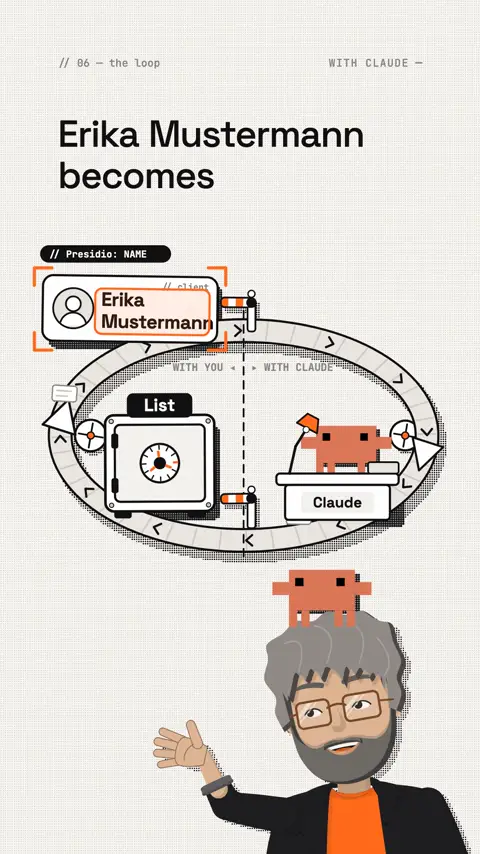
The idea: names and client data never leave your building in the first place.
- Your text first goes through a tool on your own computer, for example Presidio.
- It replaces names, IBANs and ID numbers with placeholders: Erika Mustermann becomes
<PERSON_1>. - The mapping list (
<PERSON_1>= Erika Mustermann) stays with you. - Only the placeholder text goes to Claude.
- The answer comes back with placeholders, and your loop puts the real names back in.
Presidio
- Open source, MIT licence, formerly a Microsoft project, now the community project "Data Privacy Stack". Latest release on 27 October 2026.
- Finds names, emails, phone numbers, IBANs and more, using language models, patterns and checksums. Replace, redact, hash or encrypt. There is also redaction in images.
- Languages: the default is English. For other languages you add a language model (spaCy). There are 13 German recognisers (tax ID, ID card, passport, number plates, trade register and more), switched off by default.
- Limit: Presidio itself says there is no guarantee it finds everything. Unusual names or indirect hints ("the owner of the bakery on the market square") slip through.
- Tip: add your client names from your CRM as your own list, then Presidio finds them reliably.
Ready-made building blocks
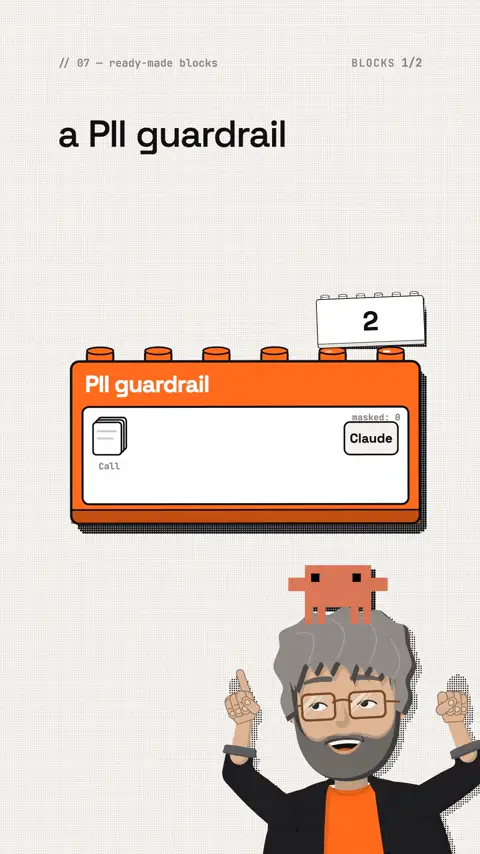
- LiteLLM Presidio guardrail (open source): a gateway in front of the model.
pre_callmasks every request,output_parse_pii: Trueputs the original values back into the answer. Claude Code can point at such a gateway viaANTHROPIC_BASE_URL. - Claude Code hook: a guard that runs on your own computer before anything goes out. Details in the section "The hook in Claude Code" below.
- Not recommended: LLM Guard is archived and has no German. NeMo Guardrails only documents English.
The hook in Claude Code: doesn't real data already go out?
No, if it's set up right. The key is the difference between two things with almost the same name:
- Claude Code is a program that runs on your own computer (or your own server).
- Claude, the AI model, runs at the provider: at Anthropic, or via AWS Bedrock in the EU.
A hook is a small script that Claude Code starts on your computer, at fixed points.
How it works
- You type a prompt and press Enter.
- Before anything goes to the model, Claude Code runs your
UserPromptSubmithook, locally. - The hook checks the text, for example with Presidio or a list of your client names.
- If it finds client data, it blocks (exit code 2). According to the Claude Code docs, a blocked prompt never reaches the model. You get a message like "Please pseudonymise first".
- If it finds nothing, the prompt goes to the model as usual.
For files there's a second hook: when Claude reads a file, the reading happens locally. A PostToolUse hook can mask the result (updatedToolOutput), and only the masked text goes to the model.
Limits, honestly
- It only stops what it recognises. A name that Presidio or your list misses goes out. That's why you check samples.
- Stop, not rewrite: a
UserPromptSubmithook can't pseudonymise your prompt automatically. For that you use the loop or the LiteLLM guardrail. - Local only: in Claude Code cloud sessions (in the browser) your local hooks don't run. The protection applies to Claude Code on your own computer or server.
- You build it yourself: I found no ready-made, tested Presidio hook for Claude Code. Test it with sample texts without real data.
- No replacement for the contract: everything that isn't stopped goes to the model. You still need the data processing agreement with your provider.
Prompt to copy
Prompt to copy
Build me a UserPromptSubmit hook for Claude Code that runs locally. It should check every prompt with Presidio and my client list clients.txt and block as soon as it finds a name, an IBAN or an email address. The message should say what was found. Add it to .claude/settings.json and test it with three sample prompts without real data.Which way fits you?
The choice depends less on the technology than on your data and your team.
| You are … | Usually fits | Why |
|---|---|---|
| Self-employed or a small office, little client data in prompts | Langdock (or a similar provider) | Works right away in the browser, the DPA is included, no tech needed. You simply leave client data out. |
| A team in a mid-sized company, many people, mixed tasks | Langdock for everyday work, the loop for the one sensitive task | The team works comfortably, quotes with real names run through the loop. |
| Law firm, practice, tax office | The loop, plus checking the add-on agreement for professional secrecy | Professional secrecy demands that as little real data as possible leaves. |
| A developer using Claude Code | A hook or the LiteLLM guardrail | You work in the terminal anyway and can set up the guard yourself. |
A good test: write down ten typical prompts from your day. If more than two of them contain real names, the loop is worth it.
Your GDPR duties, whichever way
No provider and no loop takes these points off your hands. They apply to Langdock just as much as to your own loop.
| Duty | What you actually do |
|---|---|
| Legal basis (Art. 6 GDPR) | Be clear why you may process the data, for example to fulfil a contract or out of legitimate interest. Health data and other special categories also need Art. 9. |
| DPA (Art. 28) | Have a data processing agreement with every provider that processes data for you. With Langdock it is in the terms, with the model provider of your loop you sign it yourself. |
| Record of processing (Art. 30) | Add the AI tool as its own processing activity: purpose, kinds of data, recipients, deletion periods. |
| Information (Art. 13 and 14) | Update your privacy notice and client information: which AI services you use, what for, and where the data goes. |
| Third countries (Art. 44 ff.) | If data goes to the US, you need a basis such as the EU-US Data Privacy Framework or standard contractual clauses. Check which one the provider relies on. |
| Security (Art. 32) | Access with roles and two-factor login, chat retention set as short as possible. |
| Impact assessment (Art. 35) | With high risk, check and document beforehand, for example with health or client data on a larger scale. |
| Data subject rights (Art. 15 to 17) | Access and erasure must also work for what sits in the AI tool. Know where to find and delete chats. |
| AI literacy (Art. 4 AI Act) | Mandatory since 2 February 2025: whoever works with AI in your team gets trained. A short internal rule on what may go in and what may not is the start. |
Rule of thumb: the fewer real names and client data the model sees, the smaller each of these tasks gets. That is exactly what the loop is for.
Two honest notes
- Presidio doesn't catch everything. Check samples by hand regularly, especially at the start.
- For you, the data stays personal data. You hold the mapping list, so the GDPR still applies (Recital 26, EDPB guidelines 01/2025). The loop lowers the risk and helps with data minimisation, but it doesn't replace the agreement with your model provider. Only true anonymisation takes data out of the GDPR.
Three misunderstandings that often get expensive
"The server is in the EU, so everything is GDPR compliant." Location is just one piece. You still need a DPA, a legal basis, information for your clients and clarity about which sub-processors are involved. Especially with tools that offer several models, each model can run on a different backend.
"I replaced the names, so the data is anonymous." Not for you. As long as you hold the mapping list, the data is only pseudonymised and stays under the GDPR. The loop lowers the risk a lot, but it does not remove your duties.
"No training means my data is gone right away." No training only means the model does not learn from your data. It can still be stored, for example for abuse checks or logs. So always ask separately about training and about retention.
Other no-tech providers
| Provider | Price (according to the pricing page) | Special feature |
|---|---|---|
| nele.ai | Credits from €10 net per month | Servers in the EU, Claude available, optional filtering of personal data before the AI |
| meinGPT | from €18 per user per month plus model budget | Hosted in Germany and the EU, ISO 27001 |
| Mistral Le Chat Team | 24.99 USD per user per month | French provider, no Claude |
For all of them: ask in writing about backend, region, retention and the data processing agreement.
Your first hour
- Decide: simple (Langdock), control (the loop), or both.
- With Langdock: create a trial and ask the seven questions above in writing.
- With the loop: install Presidio and switch on the language model you need.
- Run ten of your own texts without real client data through it and check what it finds.
- Only then work with real data, with samples.
My tip
Start small with both: Langdock for your team's everyday work, without client data. And a loop with Presidio for the one task that contains names, for example quotes or client emails. That way you get to know both ways before you commit.
All prices, features and links checked on 1 November 2026 on the providers' pages and in the documentation; the security badges on 3 November 2026 on langdock.com/security. Prices change, check before you buy.
The reel on this topic
This reel was made with Mentor Reels
Mentor Reels is a skill for Claude Code. From one prompt it makes a finished explainer reel with voice, animation, post texts and a PDF just like this one.
Read the transcript
"AI and GDPR? Impossible." Wrong. Tricky, but solvable. With Langdock your whole team uses Claude, from twenty-five euros a month, without a single line of code. Langdock is a Berlin AI workspace in the browser: chat, agents, workflows. Hosted in the EU, the data processing agreement applies automatically, and lawyers and doctors get an add-on agreement. Plus: ISO 27001 and SOC 2 audits, GDPR aligned, and your data isn't used to train the AI. Good signs. But honestly: which server your Claude model actually runs on there isn't clear on their site. Ask in writing. And no tool makes you GDPR-compliant automatically. That's why there's a second way, with more control: the names never leave your building in the first place. You do that with Presidio. Free and open source. It finds names, IBANs and ID numbers in your text and replaces them with placeholders on your own computer. Erika Mustermann becomes person one. Claude only sees the placeholder, the list stays with you. When the answer comes back, your loop puts the real names back in. There are ready-made building blocks too: a PII guardrail in Lite L L M in front of every call, or a hook that checks on your own computer and stops prompts with client data before they go out. Two honest notes: Presidio doesn't catch everything, so check samples. And for you, the data stays personal data. The loop lowers the risk, it doesn't replace the agreement. So for you: if you want it simple, take Langdock. If you want full control, build the loop. Or both. Follow me and comment GDPR, and I'll send you the guide for the loop, the questions to ask Langdock, and the alternatives.
Frequently asked questions
May I use Claude with client data?
Yes, but not just like that. You need a data processing agreement with the provider, a legal basis, information for your clients and clarity on where the data is processed and how long it is stored. The safest way is for real names never to reach the model at all. That is what your own loop is for. This is orientation, not legal advice: with sensitive data, talk to your data protection officer.
What is Langdock?
An AI workspace from Berlin that runs in the browser: chat, agents and workflows with Claude and other models. It is hosted on Microsoft Azure in the EU, the DPA is part of the terms, and there is an add-on agreement for lawyers, doctors and tax advisers bound by professional secrecy. What is open is which backend each Claude model runs on. Ask Langdock that and six more questions in writing, the guide has them as a checklist.
What do ISO 27001, SOC 2 Type II and "GDPR fully aligned" mean?
ISO 27001 means an outside auditor confirmed that Langdock runs a working information security system, checked again every year. SOC 2 Type II is a US audit that checks over several months that the security controls actually work. "GDPR fully aligned" is Langdock's own assessment, because there is no official GDPR certificate for any provider. All three are good signs, but they do not replace your own duties.
What is your own loop with Presidio?
Your text first runs through Presidio, a free open-source tool on your computer. It replaces names, bank account numbers and ID numbers with placeholders like PERSON_1. Only that text goes to Claude, the mapping list stays with you. When the answer comes back, the loop puts the real names back in. For other languages than English you add the matching language model and switch on the recognisers you need.
Is the data anonymous after the loop?
No. Because you hold the mapping list, the data is only pseudonymised for you and stays under the GDPR (Recital 26, EDPB guidelines 01/2025). The loop lowers the risk and helps with data minimisation. You still need the DPA with your model provider. And Presidio does not catch everything, so regular spot checks are part of it.
Can a hook in Claude Code stop client data from going out?
Yes, if it is set up right. A UserPromptSubmit hook runs on your computer before the prompt reaches the model. If it finds a name or a bank account number it blocks, and according to the Claude Code docs the prompt never reaches the model. But it only stops what it recognises, it does not rewrite the prompt itself, and it does not run in cloud sessions in the browser. The guide has a prompt that gets Claude to build such a hook for you.
What does it cost?
Langdock Business costs €25 net per user per month according to the pricing page, Business Max €99. Presidio and LiteLLM are free and open source, plus the cost of the model and your time to set it up. No-tech alternatives are nele.ai from €10 net per month and meinGPT from €18 per user per month plus a model budget. Prices change, check them before you buy.
Where should I start?
Decide whether you want it simple (Langdock), control over the data (the loop) or both. With Langdock, create a trial and ask the seven questions from the guide in writing. With the loop, install Presidio with the language model you need and run ten of your own texts without real client data through it. Only once you see what it finds do you move on to real data, with spot checks.
Keywords
Goes well with
-
// Skills, repos & add-ons
ArtCraft: 14 open-source apps instead of a subscription, built with Claude
One team is rebuilding Photoshop, Excel, AutoCAD and more as free open-source apps, with Claude on every fifth commit. All 14 apps, MCP commands and the honest limits.
-
// AI workflows for business
Your AI agent office: three ways to keep client data private
An AI agent writes reports, crunches numbers and builds slides. Three ways to keep your data private while it does: local (including NVIDIA DGX Spark), your own GPU server, or Claude in your own AWS account. With costs for every company size.
-
// AI workflows for business
Your AI council in Claude: seven advisor roles for real decisions
roast-room seats AI roles from Bezos to Buffett around your decision, Claude moderates three rounds, and you get a verdict with next steps.
-
// AI workflows for business
Claude becomes your SEO machine: real search data instead of guessed numbers
Why Claude guesses at search volume, how it pulls real Google numbers through DataForSEO, and why full keyword research costs only cents.
AI and GDPR: tricky, but solvable
Claude with client data, can it work? Two ways: Langdock from Berlin, which runs in the browser without any tech, or your own loop with Presidio that swaps names for placeholders before sending. With the security badges in plain words and your GDPR duties as a checklist.